Jurupa Valley & Surrounding Areas
Jurupa Valley Heavy-Duty Towing
Big-rig, semi-truck, and bus recovery with the right wreckers — fast across the SR-60 and I-15 freight corridor in Jurupa Valley.
I have a semi or bus down — do you have equipment rated to recover it?
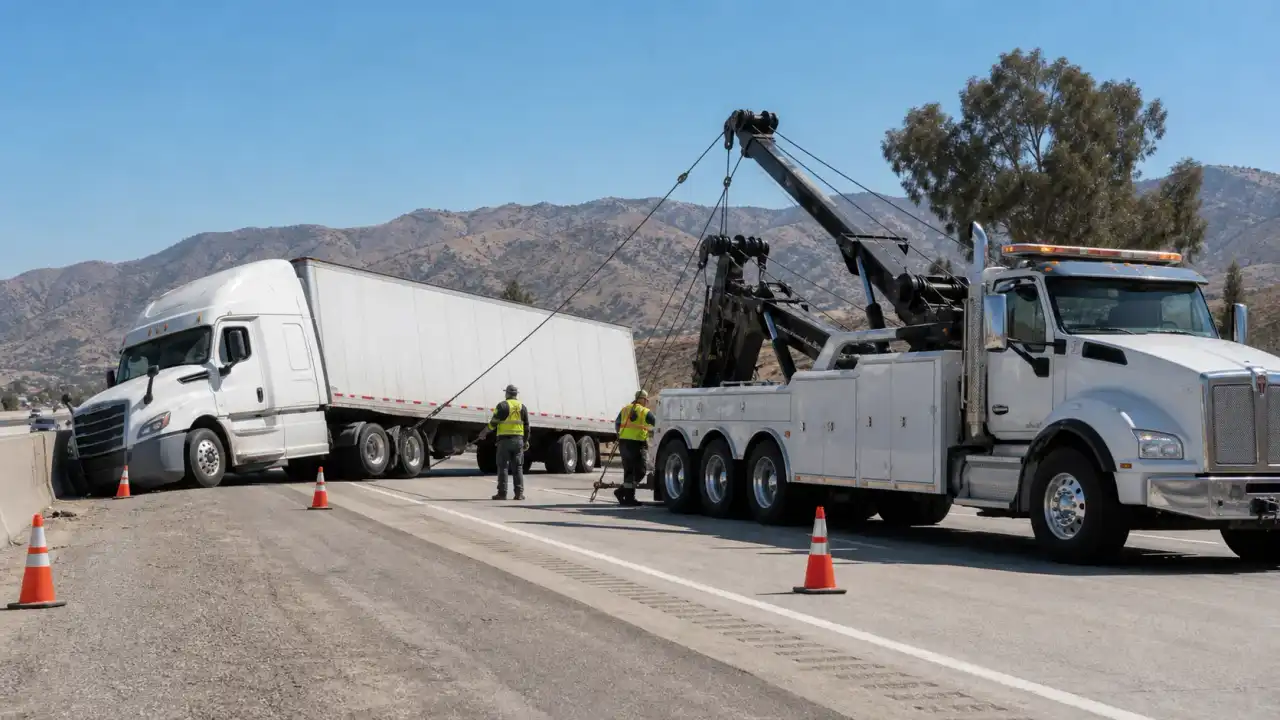
Heavy-duty towing recovers class 7 and class 8 vehicles — semi-tractors, tankers, cement mixers, motor coaches, and loaded trailers — across Jurupa Valley, CA and the SR-60 / I-15 freight corridor. It is the service for carriers, fleet managers, and drivers whose rig is disabled on a freeway shoulder, at a warehouse dock, or off the roadway entirely. We run rotators and 50-ton underlift wreckers, quote before we rig, and dispatch around the clock.
What Does a Heavy-Duty Tow Actually Involve?
Heavy-duty towing in Jurupa Valley means moving vehicles well above 26,000 lb GVWR with equipment built for it: rotators, 50-ton underlift wreckers, and heavy integrated units. That covers class 7 and class 8 trucks, semi-tractors, cement mixers, flatbed trailers, tankers, and motor coaches. Given the freight volume through this part of Riverside County, it is core work for us rather than an occasional add-on.
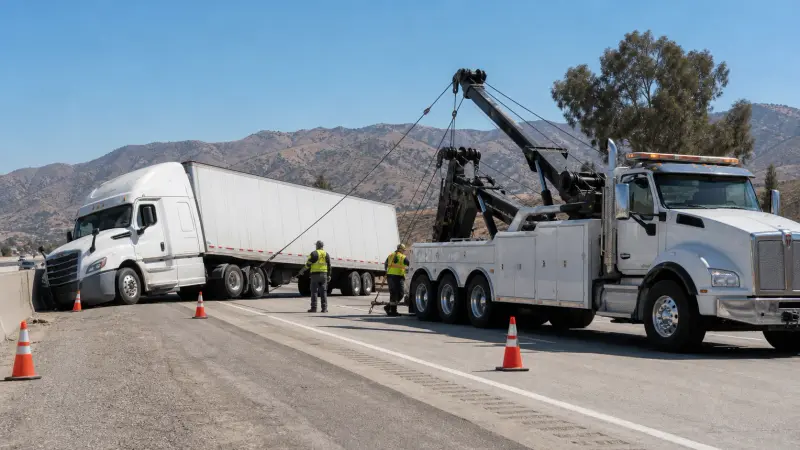
The job starts before any hook goes on. Our operators assess the scene, decide whether the vehicle can be lifted as it sits or has to be uprighted first, plan the rigging and the anchor points, and clear the area of bystanders. Only then does load go on the cable. For jackknifed trailers or overturns we deploy rotators with the reach to right a tipped semi from the roadway side, which keeps lane closures as short as possible.
When Should You Call for Heavy-Duty Recovery?
Call the moment a class 7 or 8 vehicle stops being drivable in Jurupa Valley — a disabled semi on the SR-60 shoulder near the I-15 junction, a bus with a failed air system, a cement mixer that has dropped a drive axle, a jackknifed trailer, or an overturn anywhere on the corridor. A rig sitting in or beside a live traffic lane is a safety emergency: CHP will expedite clearance, and every minute it stays raises the risk of a secondary collision.
Not every heavy call is on a freeway. The dense warehouse grid around Mira Loma — Rider Street, Wineville Avenue, and the streets feeding them — generates its own recoveries: trucks stuck in tight dock positions, rigs that slid into drainage channels, and vehicles with blown drive tires that must be moved without being driven. Those get the same equipment and the same planning as a freeway scene.
Why Do So Many Rigs Go Down on the 60/15 Corridor?
The 60/15 interchange near Jurupa Valley is one of Southern California's most active freight chokepoints, and the geometry works against heavy vehicles. Steep grades, tight merges, narrow pull-outs on the eastbound side, and constant congestion mean brakes run hot, cooling systems work at their limits, and drivers make abrupt inputs at exactly the wrong moment. Volume does the rest: thousands of loaded rigs a day produce failures in proportion to the miles.
The consequences compound quickly when nothing is done. A rig left on a shoulder becomes a secondary-collision risk within minutes. A trailer that has jackknifed but not tipped can still go over if it is moved carelessly. And a truck with a failed air system parked on a grade is a hazard to everyone around it. This is why heavy recovery is planned rather than improvised — the wrong pull can turn a recoverable vehicle into a total loss.
What Affects the Cost of Heavy-Duty Towing?
Heavy-duty rates in Jurupa Valley are higher than light-duty by nature: the equipment is specialized, the liability is real, and the work is technically complex. What moves the number on a given job is the class and weight of the vehicle, whether it is loaded, how much recovery work is needed before it can be towed, how many units and operators the scene requires, and the distance to the destination.
Two factors are specific to this corridor. Freeway scenes that require lane control or coordination with CHP take longer and involve more equipment than a yard recovery of the same vehicle. And any oversized or overweight tow that needs a Caltrans permit or escort adds cost and lead time — we handle that coordination, but it is part of the quote. You get a clear number before we proceed and updates throughout, not a bill that materializes at the end.
Do You Need a Heavy-Duty Tow or a Recovery First?
If your rig is upright on pavement anywhere in Jurupa Valley and simply cannot drive, it is a straight heavy-duty tow: we lift it and move it. If it has left the traveled way, tipped, jackknifed, or buried an axle, the job starts as a recovery — winching, rigging, and often a rotator to right it — and only becomes a tow once the vehicle is back on the roadway. Recovery is quoted separately because it is genuinely separate work.
The weight class decides the rest. Under 26,000 lb GVWR, medium-duty towing handles it with a smaller wrecker at a lower cost. Above that, and for anything with a trailer attached, heavy-duty equipment is the only safe option. If you are unsure, tell dispatch the configuration, the weight, whether the rig is loaded, and what position it is sitting in — that is enough for us to send the right unit rather than a truck that has to turn around.
How Do You Handle Overturns and Jackknifed Trailers?
Overturn work on the SR-60 and I-15 through Jurupa Valley is rotator work. We assess the scene and the load, plan the rigging so the pull comes from an angle that rights the vehicle rather than dragging it, set anchors, and keep everyone clear of the cable path before applying force. Where the trailer is loaded, the load has to be accounted for in the plan — a shifting load mid-lift is how recoveries go wrong.
We coordinate with CHP, emergency services, and Caltrans as the scene requires, and we do not rush the plan to shave minutes. A clean execution that takes twenty minutes longer beats a fast pull that damages the tractor, drops the load, or closes a second lane.
We also provide truck towing , winching & recovery , flatbed towing , and medium-duty towing throughout Jurupa Valley — our trucks are equipped for multiple job types in a single dispatch.
Related services
Got questions
Frequently Asked Questions
Don't see your question? Call us — a dispatcher picks up 24/7.
How fast can you reach a breakdown on the SR-60 in Jurupa Valley?
For freeway heavy-duty calls on the SR-60 corridor, we typically aim for a 30–60 minute response. Exact ETA depends on which unit is available and current traffic, but we prioritize freeway calls because of safety urgency — let dispatch know you're on the freeway when you call.
What size vehicles can your heavy-duty wreckers handle?
Our heavy-duty equipment handles class 7 and class 8 trucks — semi-tractors, tankers, cement mixers, motor coaches, and heavy trailers. Rotator and 50-ton underlift units cover the full range. If you're unsure whether your rig qualifies, tell us the weight and configuration and we'll confirm.
Can you recover an overturned semi on the freeway?
Yes. Rotator-based semi recovery is a specialized service we provide. We'll assess the scene, plan the right rigging approach, and coordinate with emergency services and Caltrans as needed. Safety and a clean execution come before speed on any overturn job.
Is the recovery charged separately from the tow?
Yes. Uprighting, winching, and extraction are quoted separately from the tow itself because they need extra equipment, rigging labor, and time. You get both numbers before we start — nothing is added after the fact.
Free estimate
Talk to a real dispatcher.
No runaround.
Fill this out and a dispatcher will call you right back with a clear price and an honest ETA — no obligation, no sales pitch.
Why Jurupa Valley calls us first
A tow company that
acts like one.
We've been pulling cars out of ditches, off highway shoulders, and out of tight parking garages across Jurupa Valley and the Inland Empire long enough to know what actually matters when you're stranded — speed, clear pricing, and a driver who treats your vehicle like their own.
"Satisfaction guaranteed — we get there fast or we make it right."
- 01 24/7 emergency dispatch
- 02 Fast local ETA
- 03 Licensed & insured
- 04 Upfront pricing — no surprises
- 05 All vehicle types
Reach us today
Stranded in Jurupa Valley?
We're ready right now.
Our dispatchers are on the line 24/7 — no hold music, no callback queue. Tell us where you are and we'll tell you exactly when we'll arrive and what it costs.